NOTE FOR AHN(安), GALLERY 175, SEOUL, SOUTH KOREA, 2019
Exhibition Note for AHN (安) was a two-person exhibition I organized with Ahn Jaeyoung, which began from the question of whether an individual could escape from being possessed — one of the mysterious symptoms containing elements of superstition from Korea. The exhibition, tracks how images attained from one’s superstitious beliefs relate to mythical and religious images, then recombines and deconstructs them. Under our collaboration lies the hope to contact invisible but clearly existing sensual phenomena, and to together overcome anxieties, interpreting phenomena as the destiny of artist/mediator.
Paying attention to the number of tattoos on Ahn Jaeyoung‘s body (the Chinese character 安, a blue diamond, an arrow, a red-haired Anne, Piglet, Mickey Mouse, and an epitaph of Nikos Kazantzakis), I interpreted each image as a charm to ward off Ahn’s anxieties. I then, researched mythical and religious imagery in order to strengthen the shamanistic narrative. Observing that the number 12 frequently works as important motive in the myths of many different cultures, I set Ahn Jaeyoung‘s birthday, December 12, as a central axis and tried to discover the references to god-related signs from the number 12. Combining the symbolic world of the image, language, color, and numbers from ancient myths from twelve animals that guards tombs, I created a chart for a system of faith and proposed a psychological space for a praying man, just like the secret connotation of the ancient character, 安
NOTE FOR AHN(安), GALLERY 175, SEOUL, SOUTH KOREA, 2019
Exhibition Note for AHN (安) was a two-person exhibition I organized with Ahn Jaeyoung, which began from the question of whether an individual could escape from being possessed — one of the mysterious symptoms containing elements of superstition from Korea. The exhibition, tracks how images attained from one’s superstitious beliefs relate to mythical and religious images, then recombines and deconstructs them. Under our collaboration lies the hope to contact invisible but clearly existing sensual phenomena, and to together overcome anxieties, interpreting phenomena as the destiny of artist/mediator.
Paying attention to the number of tattoos on Ahn Jaeyoung‘s body (the Chinese character 安, a blue diamond, an arrow, a red-haired Anne, Piglet, Mickey Mouse, and an epitaph of Nikos Kazantzakis), I interpreted each image as a charm to ward off Ahn’s anxieties. I then, researched mythical and religious imagery in order to strengthen the shamanistic narrative. Observing that the number 12 frequently works as important motive in the myths of many different cultures, I set Ahn Jaeyoung‘s birthday, December 12, as a central axis and tried to discover the references to god-related signs from the number 12. Combining the symbolic world of the image, language, color, and numbers from ancient myths from twelve animals that guards tombs, I created a chart for a system of faith and proposed a psychological space for a praying man, just like the secret connotation of the ancient character, 安
The rapt of Proserpina,Joseph-Marie Vien, 1767, Musée de Grenoble
Installation view at 698-9 Seonosong-dong, Jeonju
( February 21 - March 06, 2020), as part of Print/Out,
Photo by Minkyoung Choi
Installation view of Jan van eyck academie openstudios 2021 Still cut, The geometry of the hunter, Single channel video, 2021

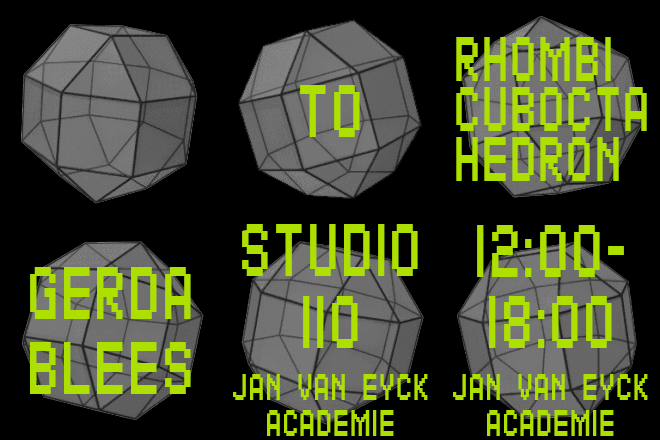

Photo. Romy Finke
Return to the Rhombicuboctahedron, 2020
Beginning—
This project began with a collaboration with the writer Gerda Bless at the Jan van Eyck Academie in the Netherlands, and grew out of a shared conversation about loss within the family. At the time, Gerda was writing a novel about the Bijlmermeer disaster, the 1992 plane crash in Amsterdam, and wanted to audiovisually materialize the interior of the airplane in the novel, where a seven-year-old girl who had lost her father in the accident encounters him.
Around the same time, my grandmother suddenly passed away. My family did not tell me until the final day of the 49-day mourning period, amid the confusion caused by COVID-19. Before and after her death, I often encountered my grandmother in my dreams. The promise we had made in reality—“Let’s meet again next year”—could no longer be kept, yet it repeatedly resurfaced in my dreams. In an age of illness, loss was not something only Gerda and I faced; it was something everyone participating in the residency had to confront. Some had lost friends, others family members, and we were spending our time overwhelmed by grief. Through this collaborative project, I wanted to recover from my own grief and the sense of helplessness it had brought. As Gerda and I repeatedly talked about loss, I learned that she was in the early stages of pregnancy. Strangely, the news felt like a future of hope arriving from the past.
Development—
In 2019, I researched Eastern and Western symbols and associations surrounding the number twelve for a two-person project, Notes for Ahn(安). My research on the dodecahedron moved from the geometric dodecahedra of ancient Greece to the material dodecahedra of the Roman period, then through Albrecht Dürer’s Melencolia I, 1514, and Salvador Dalí’s The Sacrament of the Last Supper, 1955, finally arriving at Karel Biddeloo’s comic De Rode Ridder: De Dodecaëder, 2001. This trajectory—from ancient mathematics, alchemy, and art to a contemporary comic, and ultimately back to a tattoo image inscribed on an individual body—served as a device for entering a space directed toward my friend Ahn and the character 安(ahn), meaning “peace” or “comfort.”
Knowing this story roughly, Gerda searched for the Dutch comic De Rode Ridder: De Dodecaëder, which was unavailable in Korea, in a second-hand bookshop in Amsterdam and gave it to me as a gift. In the comic, the dodecahedron appears as an unidentified supernatural device capable of bringing about healing and transformation. Its capacity for healing and recovery became the force that guided Gerda’s and my collaboration.
Space—
In translating the dodecahedron into a physical space, I needed a form with more faces—one that could move beyond the dodecahedron’s constricted interior and angular structure toward a form closer to a sphere. The Rhombicuboctahedron Fold-Up Pattern, a flat development of a 26-faced polyhedron, functions simultaneously as a blueprint for a three-dimensional space occupied by a single viewer, the interior of a crashed airplane, and a three-dimensional capsule serving as a temporary altar. The twenty-six faces of the development form two symmetrical axes: Pattern I, containing vision, life, and the universe; and Pattern II, recording sound, memory, and flight. The vertical axis represents falling and rising. Yet once grounded as a physical space, this hierarchy is inverted, and falling and rising operate as a cyclical chain of images. The structure, folded from the variable and fragile materials Gerda proposed—cardboard and tape—was initially a practical choice, as these materials were inexpensive and readily available. But because they could be easily folded, dismantled, and reassembled, they also seemed suited to becoming the material of a “temporary connection device” through which one might encounter an existence beyond reality.
Encounter—
The viewers, most of whom were fellow residents, each spent time alone inside the twenty-six-faced space, separated from the outside world. A cassette tape player placed at the center of the space contained letters recorded by Gerda and me in our respective native languages, and the viewers could record their own messages onto the tape afterward. Although the contents of the letters, recorded in different languages, were not necessarily comprehensible to one another, the tone, breathing, and silences of the voices connected them through grief and longing.
Return—
As viewers emerged from the space, Gerda, the viewers, and I would often embrace each other. Gerda and I copied the recordings onto cassette tapes and each kept a set.

